

Being busy and being productive are not the same thing. You can spend six hours “studying” and still walk away with nothing done, because you reread the same page four times while checking your phone between paragraphs. That’s the trap most students fall into, and it’s why generic advice like “just focus more” never actually works.
This guide covers real productivity tips for students, the kind that hold up when you have three assignments due Friday, a shift at work on Wednesday, and an exam next week. It’s built around a simple loop: plan, prioritize, focus, learn, recover, review.
Each tip below fits into that loop somewhere, so by the end you’ll have a system, not just a pile of tips. Along the way, best AI productivity tools can also help you organize tasks, summarize study material, manage your time, and reduce repetitive work.
What Does Productivity Mean for Students?
Student productivity means getting your most important academic work done well, using the time and energy you actually have, not the time and energy you wish you had.
Productivity vs. studying longer
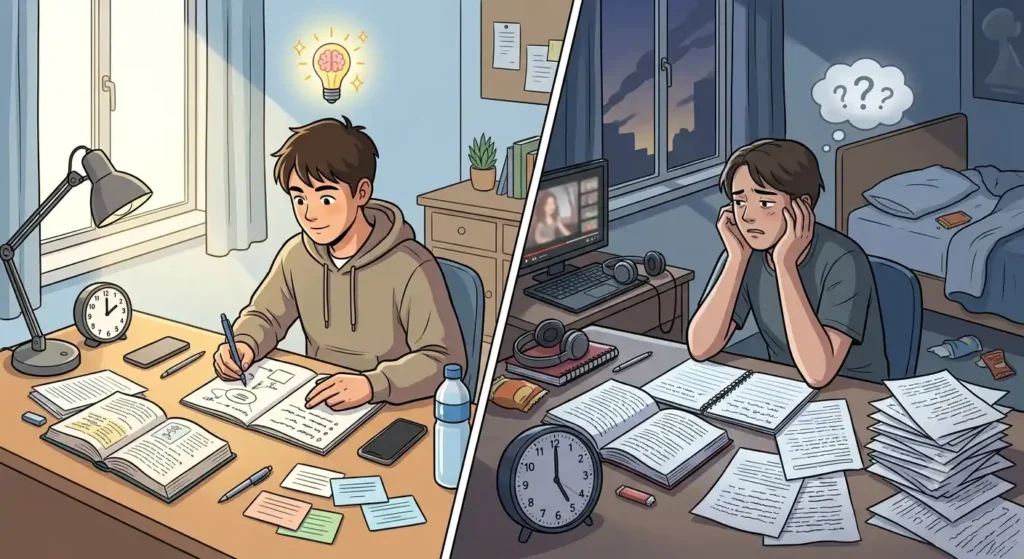
Studying longer isn’t the same as studying better. A student who studies for two focused hours using active recall will usually retain more than one who rereads notes for five hours while half-watching a show in the background.
Productivity vs. being busy
Busy means your calendar is full. Productive means the things that matter most actually got finished. You can be busy all semester and still miss the deadlines that count.
What productive students actually optimize
Productive students aren’t managing hours so much as they’re managing five things:
Time, attention, energy, learning, and recovery. Miss any one of these and the system breaks, a perfectly scheduled week falls apart if you haven’t slept, and a well-rested student with no plan still misses deadlines.
Why Is Productivity Important for Students?
Complete assignments without last-minute stress
When you plan ahead, a paper due in three weeks gets worked on in three weeks, not the night before. That alone removes most of the panic that comes with deadlines.
Create more time for yourself
Every hour you waste rereading the same paragraph or scrolling between tasks is an hour you don’t get back for friends, sleep, or rest. Working efficiently during school hours buys you real free time later.
Improve consistency and academic performance
Small, steady effort across a semester beats sporadic cramming almost every time. Consistency is what actually shows up in your grades.
Protect sleep and wellbeing
A good productivity system isn’t just about output. It’s what lets you finish your work and still get to bed at a reasonable hour, which matters more than most students realize.
25 Productivity Tips for Students
1. Put every deadline into one calendar
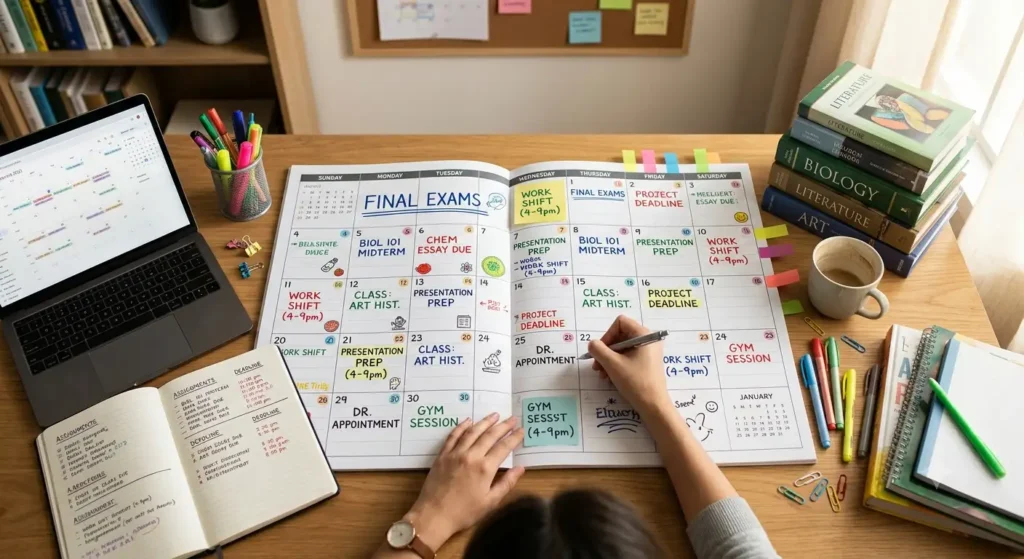
Pick a single calendar, Google Calendar, Outlook, or a paper planner, and put everything into it: exams, assignments, projects, class times, work shifts, and personal commitments. If a deadline lives in your head or in three different apps, something will eventually slip through.
Semester calendar example
At the start of the term, sit down with every syllabus you have and block out major due dates for the next four months. Even a rough version of this beats starting from zero every week.
2. Turn your syllabus into a semester plan
A syllabus is more useful than most students treat it. Pull out every deadline the first week, then work backward from each one to set your own prep dates a few days early, with buffer time in case something goes wrong.
3. Plan your week before it starts
Spend fifteen minutes on Sunday mapping out the week ahead, rather than deciding each morning what today looks like.
Weekly planning checklist
- Fixed commitments (classes, shifts, appointments)
- Study blocks for each course
- Assignments due that week
- Revision or review sessions
- Exercise
- Meals
- Rest
- Social time
4. Choose your top three priorities each day
A to-do list with twenty items on it usually just creates anxiety. Pick the three tasks that matter most today, finish those, and treat everything else as a bonus.
5. Break large assignments into smaller tasks
“Write a research paper” is not a task, it’s a project pretending to be a task. Your brain resists starting things that feel that big.
Example: turning “write research paper” into five actions
- Choose a topic and confirm it with your professor
- Find and read five sources
- Write an outline
- Draft the introduction and body
- Edit and format the final version
6. Use time blocking for focused study
Time blocking means assigning specific hours on your calendar to specific tasks, instead of leaving study time as a vague intention. “Study for chemistry” becomes “9–10:30 am: chemistry chapter 4 problems.”
Example student time-blocked schedule
A student with a 2 pm biology exam might block 9–10 am for flashcard review, 10–10:15 for a break, and 10:15–11 for practice questions, rather than “studying all morning” with no structure.
7. Find your highest-energy study hours
Not everyone works best at 6 am, and not every student should force themselves into an early study routine that doesn’t fit their body. Track your energy for a week and schedule your hardest subjects during whatever window you’re sharpest in, whether that’s morning, afternoon, or evening.
8. Start with the task you’re most likely to avoid
This is sometimes called “eating the frog”, doing the task you’re dreading first, while your willpower is highest. Once it’s done, everything else on your list feels lighter by comparison.
9. Use the 2-Minute Rule when you’re procrastinating
If a task takes less than two minutes, do it immediately instead of adding it to a list — replying to an email, printing a form, or emailing a professor. For bigger tasks you’re avoiding, commit to just two minutes of it. Often the hardest part is starting, and two minutes turns into thirty once you’re moving.
10. Try the Pomodoro Technique
How Pomodoro works
Set a timer for 25 minutes, work with full focus, then take a 5-minute break. After four rounds, take a longer break of 15–30 minutes.
When to use it
Pomodoro works well for tasks you’re avoiding, or subjects that require sustained concentration like reading dense material or working through math problems.
When not to use it
Don’t treat 25 minutes as a rule carved in stone. If you’re in deep flow on an essay, stopping at exactly 25 minutes can break your momentum for no good reason. Adjust the interval to fit the task.
11. Stop multitasking
Switching between tasks, texting while reading, or jumping between two assignments, comes with a real cost. Each switch takes a few seconds to a few minutes to fully refocus, and that adds up across a study session. Pick one task, work on it, then move to the next.
12. Put your phone out of reach
Willpower alone rarely beats a phone sitting next to your notes. Physical distance works better than good intentions.
Student distraction checklist
- Turn on Do Not Disturb
- Silence non-essential app notifications
- Use a website blocker during study blocks
- Leave your phone in another room, not just face-down
- Turn off smartwatch alerts
- Log out of social media on your laptop during study time
13. Create a study environment that supports focus
Your environment does a lot of the work before you even open a book. A cluttered desk, bad lighting, and background noise all quietly pull at your attention.
Pay attention to lighting, noise level, your desk setup, ergonomics, and whether you have every material you need before you sit down. Close unrelated browser tabs, and if you study at home, let roommates or family know when you need quiet time.
14. Use active recall instead of rereading everything
Active recall means testing yourself on material instead of just rereading it. Rereading feels productive because the content looks familiar, but familiarity isn’t the same as knowing it.
Example
Read a chapter once, close the book, and try to recall the main points from memory. Then check what you missed and go back only to the gaps, rather than rereading the whole chapter again.
15. Use spaced repetition for long-term retention
Spaced repetition means reviewing material at increasing intervals, a day later, then three days, then a week, instead of cramming it all at once. Flashcard tools like Anki build this schedule for you automatically, which makes it especially useful heading into exams.
16. Practice with questions, not just notes
Practice tests, past papers, and self-quizzing tell you what you actually know, which rereading your notes cannot. Explaining a concept out loud, as if teaching someone else, is another way to expose the parts you don’t understand yet.
17. Take deliberate breaks
Breaks aren’t wasted time. They’re what let you come back to a task with attention instead of running on fumes.
What to do during a productive break
Walk around, stretch, eat something, drink water, or rest your eyes away from a screen. Just watch the clock, a 5-minute break has a way of turning into 45 minutes of social media if you’re not careful.
18. Build accountability into your routine
Telling someone else your plan makes you more likely to follow through on it.
Study buddy
Someone to check in with about a specific class or assignment.
Accountability partner
Someone outside your coursework who simply asks how your week went.
Study group
A regular group that meets to review material together, which also gives you a deadline to actually prepare before showing up.
19. Use office hours and academic support
Asking for help early is a productivity move, not a sign of falling behind. A five-minute conversation with a professor can save you hours of confused, unproductive studying later. Tutoring centers, academic advisors, libraries, and writing centers exist specifically for this.
20. Learn to say no
Every extra commitment, a club, a shift, a social event, takes time away from something else. Before you say yes to something new, check it against your calendar and your actual priorities for the week, not just how you feel about it in the moment.
21. Protect your sleep
Why sleep belongs in a productivity system
Sleep affects memory consolidation, focus, and mood, all of which directly affect how well you study and perform on exams. Skipping sleep to study more often costs you more than it gives back.
What to do during exam periods
Keep a consistent sleep schedule even during exam week, and treat an all-nighter as a last resort rather than a strategy. A well-rested brain recalls information far better than an exhausted one cramming at 3 am.
22. Don’t confuse productivity with constant busyness
There’s a pattern sometimes called toxic productivity, where rest starts to feel like something you need to earn rather than something you’re allowed to have.
Signs of toxic productivity
- Feeling guilty while resting
- Studying unnecessarily long hours with no real benefit
- Ignoring sleep to squeeze in more work
- Measuring your worth by how much you got done
- Never taking a real break
23. Build a productivity system for your specific situation
A generic student schedule doesn’t work for every student, because not every student’s week looks the same.
Full-time student
More flexibility to build study blocks around class times, but also more room to procrastinate without structure.
Working student
Needs to treat work shifts as fixed calendar blocks and plan study time around them, not the other way around.
Student-athlete
Practice and travel schedules should go into the calendar first, with study blocks fit around them, not squeezed in as an afterthought.
Graduate student
Often juggling research, teaching, and coursework at once, which makes weekly planning and saying no to extra commitments especially important.
Online student
Without fixed class times to anchor the day, self-imposed structure through time blocking becomes more important, not less.
Student with family responsibilities
Study blocks may need to happen in short, protected windows rather than long uninterrupted stretches, and that’s a legitimate way to build a schedule, not a compromise. A Reddit thread from a non-traditional law student balancing school, a career, and a family captures this well, the advice that works for a full-time undergrad doesn’t always fit someone managing several roles at once.
24. Use the right productivity tools
Tools should solve a specific problem, not just look impressive on a productivity blog.
Best tools by student problem
| Need | Tool category |
| Deadlines | Calendar (Google Calendar, Outlook) |
| Tasks | Task manager (Todoist, Trello) |
| Notes | Note-taking app (Notion, Evernote) |
| Focus | Focus timer or website blocker |
| Group work | Collaboration app (Trello, Asana) |
| Study review | Flashcard or spaced-repetition tool (Anki) |
| Scheduling | Calendar or scheduling tool (Calendly) |
Free vs. paid productivity tools
Most students can run a solid system entirely on free tools. Paid versions usually add extras like more storage or advanced automation, which are nice but rarely necessary in your first year of using a tool.
Don’t let productivity apps become another distraction
If you’re spending more time customizing your Notion setup than actually studying, the tool has become the problem. Pick one system and use it, rather than testing five apps every semester.
25. Review your week and adjust your system
No plan survives contact with a real week perfectly. A short review at the end of each week lets you fix what isn’t working instead of repeating the same mistakes.
Five questions to ask every Sunday
- What did I complete this week?
- What took longer than I expected?
- Where did I waste time?
- What deadlines are coming up?
- What should I change next week?
The Best Productivity Techniques for Students Compared
| Technique | Best for | Difficulty | When to use |
| Time blocking | Scheduling your day | Easy | Weekly and daily planning |
| Pomodoro | Sustained focus | Easy | Study sessions |
| Eisenhower Matrix | Prioritizing tasks | Easy | Overloaded days |
| 2-Minute Rule | Starting tasks | Easy | Procrastination |
| Pareto Principle | Finding high-value work | Medium | Large workloads |
| Spaced repetition | Long-term retention | Medium | Exam preparation |
| Active recall | Learning material | Medium | Revision |
How to Create a Productive Student Schedule
Step 1: Add fixed commitments
Classes, work shifts, and recurring appointments go in first, since these can’t move.
Step 2: Add deadlines
Every assignment, exam, and project due date gets added next, pulled straight from your syllabi.
Step 3: Add study blocks
Fill in dedicated blocks for each subject, matched to your highest-energy hours where possible.
Step 4: Prioritize difficult work
Schedule your hardest or most dreaded task earlier in the day, before energy and willpower start to fade.
Step 5: Add breaks and personal time
Rest and social time aren’t optional extras — build them into the schedule directly, or they’ll get pushed out entirely.
Step 6: Add buffer time
Leave gaps between blocks for tasks that run long, because they will.
Step 7: Review the schedule every evening
A quick five-minute check each night lets you adjust tomorrow’s plan based on what actually happened today.
Example Productivity Schedule for a College Student
| Time | Activity |
| 7:00 am | Wake up, breakfast |
| 8:00 am | Class |
| 10:00 am | Deep study block |
| 12:00 pm | Lunch |
| 1:00 pm | Class |
| 3:00 pm | Assignment work |
| 5:00 pm | Exercise or rest |
| 6:30 pm | Dinner |
| 7:30 pm | Light revision |
| 9:00 pm | Free time |
| 10:30 pm | Prepare for tomorrow |
| 11:00 pm | Sleep |
Treat this as a starting template, not a rule. Your actual day will depend on your class schedule, your job, and your energy levels, so adjust the blocks to fit your real week rather than copying this one exactly.
How to Stay Productive When You Are Falling Behind
1. Stop trying to catch up on everything at once

Trying to fix three weeks of missed work in one weekend usually backfires. Pick a starting point and work through it in order instead of attempting everything simultaneously.
2. List everything outstanding
Write down every missing assignment, unread chapter, and unfinished task in one place, so you can see the full picture instead of carrying it around in your head.
3. Identify urgent vs. important work
Some tasks are due soon; others matter more for your grade or your learning. Sort your list by both before deciding what to tackle first.
4. Contact instructors when necessary
Professors would generally rather hear from you early than find out at the deadline that you’re behind. A short, honest email can open the door to an extension or extra guidance.
5. Create a recovery schedule
Build a short-term plan, a week or two, focused entirely on catching up before returning to your normal weekly routine.
6. Focus on the next actionable task
Don’t try to solve “I’m behind in three classes” as one giant problem. Solve “finish this one reading” right now, then move to the next thing.
Productivity Tips for Students During Exam Season
1. Start with the exam calendar
Map out every exam date first, then work backward to set your revision schedule around them.
2. Prioritize subjects strategically
Spend more time on subjects where you’re weakest or where the exam carries more weight, rather than splitting time evenly across everything.
3. Use active recall and practice testing
Past papers and self-testing reveal gaps that rereading notes will not.
4. Schedule spaced revision
Review each subject multiple times across the weeks leading up to the exam, rather than once right before it.
5. Avoid all-night study sessions
Cramming through the night usually costs you more in exhaustion the next day than it gives back in extra material covered.
6. Protect sleep during the final week
This is the week sleep matters most, not the week to sacrifice it.
Common Productivity Mistakes Students Should Avoid
Trying to study all day
Long unbroken study sessions lead to fading focus, not more learning.
Creating unrealistic schedules
A schedule with zero flexibility falls apart the first time something unexpected comes up.
Multitasking
Switching between tasks costs more time than it saves.
Checking your phone constantly
Every check resets your focus back to zero.
Using too many productivity apps
More tools usually means more setup time and less actual studying.
Waiting for motivation
Motivation tends to show up after you start, not before.
Ignoring sleep
Sleep debt catches up with your grades eventually.
Confusing planning with doing
A color-coded schedule that never gets followed hasn’t accomplished anything yet.
Trying to be perfect
A study plan you actually follow at 80% beats a perfect plan you abandon in a week.
How to Become More Productive Without Burning Out
- Schedule rest the same way you schedule study time
- Keep your workload realistic instead of overloading every week
- Protect sleep even when it’s tempting to cut it
- Leave buffer time for things that take longer than planned
- Maintain your social connections, not just your GPA
- Accept that some days won’t go to plan
- Adjust your system when it’s not working, instead of abandoning it entirely
15-Minute Student Productivity Reset
If your week has gotten messy, this quick reset can get you back on track.
Minute 1–3: Brain dump
Write down everything on your mind, from assignments to errands, with no filtering.
Minute 4–6: Check deadlines
Look at your calendar and note what’s actually due soon.
Minute 7–9: Choose three priorities
Pick the three tasks from your list that matter most today.
Minute 10–12: Schedule the first focus block
Put a specific time on the calendar for the first priority, starting now if possible.
Minute 13–15: Remove distractions and start
Silence your phone, close unrelated tabs, and begin.
Frequently Asked Questions About Student Productivity
What are the best productivity tips for students?
Keep one calendar for every deadline, plan your week in advance, pick three daily priorities, use active recall for studying, and protect your sleep. These five habits cover most of what makes a student productivity system work.
How can I become more productive as a student?
Build a weekly planning habit, break large assignments into smaller tasks, and review what worked and what didn’t at the end of each week. Productivity comes from a repeatable system, not a single trick.
How can I stop procrastinating on schoolwork?
Use the 2-Minute Rule to get started on tasks you’re avoiding, and try starting with your most dreaded task first while your willpower is highest.
How many hours should a student study per day?
There’s no universal number. What matters more is focused, distraction-free study time matched to your workload, rather than chasing a specific hour count.
What is the best productivity technique for studying?
Active recall and spaced repetition are strongly supported for retention, while Pomodoro and time blocking help with staying focused during the sessions themselves.
Is Pomodoro good for students?
Yes, for many tasks, especially ones you’re avoiding or that require sustained focus. It’s less useful once you’re already in deep concentration, since stopping at a fixed interval can break your momentum.
How can I focus while studying?
Remove your phone from the room, close unrelated browser tabs, and study in an environment set up for focus rather than comfort alone.
How can I manage school, work, and social life?
Put your work shifts into your calendar as fixed blocks first, then build study time and social time around them, rather than treating work as an interruption to your “real” schedule.
What are the best productivity apps for students?
A calendar, a task manager, a note-taking app, and a spaced-repetition tool like Anki cover most needs. Pick one from each category rather than testing several apps in every category.
How do I become productive when I have no motivation?
Start with a task small enough that it doesn’t require motivation, like the 2-Minute Rule. Motivation often follows action rather than preceding it.
How can I avoid burnout as a student?
Schedule rest and sleep the same way you schedule study time, and watch for signs of toxic productivity like feeling guilty whenever you’re not working.
What should I do if I fall behind in school?
List everything outstanding, sort it by urgency and importance, contact instructors where needed, and work through a short recovery plan one task at a time instead of trying to fix everything at once.
Conclusion
Student productivity isn’t about squeezing more hours out of every day or trying to stay busy from morning until night. It’s about making the important work easier to start, easier to schedule, and easier to finish, while still protecting your energy, sleep, and personal time. The goal isn’t to build a perfect routine. It’s to create a system you can realistically follow, even when classes get busy, deadlines pile up, or your motivation is low.
If you take nothing else from this guide, start here: use one calendar to keep track of deadlines and commitments, choose three daily priorities, schedule at least one focused work block, take a real break away from your screen, and spend a few minutes each week reviewing what worked and what didn’t. Then build from there. You don’t need to change everything at once.
Add the strategies that solve your biggest problems first, whether that’s procrastination, distractions, poor time management, or difficulty staying focused. Learn what productivity tools are and how they are useful before adding new apps to your routine, so you can choose tools that actually support your study system rather than adding unnecessary complexity. Give the system a week, pay attention to what improves, and adjust it as your workload changes. Small, consistent improvements will usually take you further than an overly complicated productivity routine you can’t maintain.

Mehreen Mushtaq is a skilled content writer dedicated to creating high-quality, engaging, and SEO-focused blogs. She specializes in strategic keyword usage, search intent, and informative content that connects with readers while helping websites strengthen their visibility and rankings in search results.