

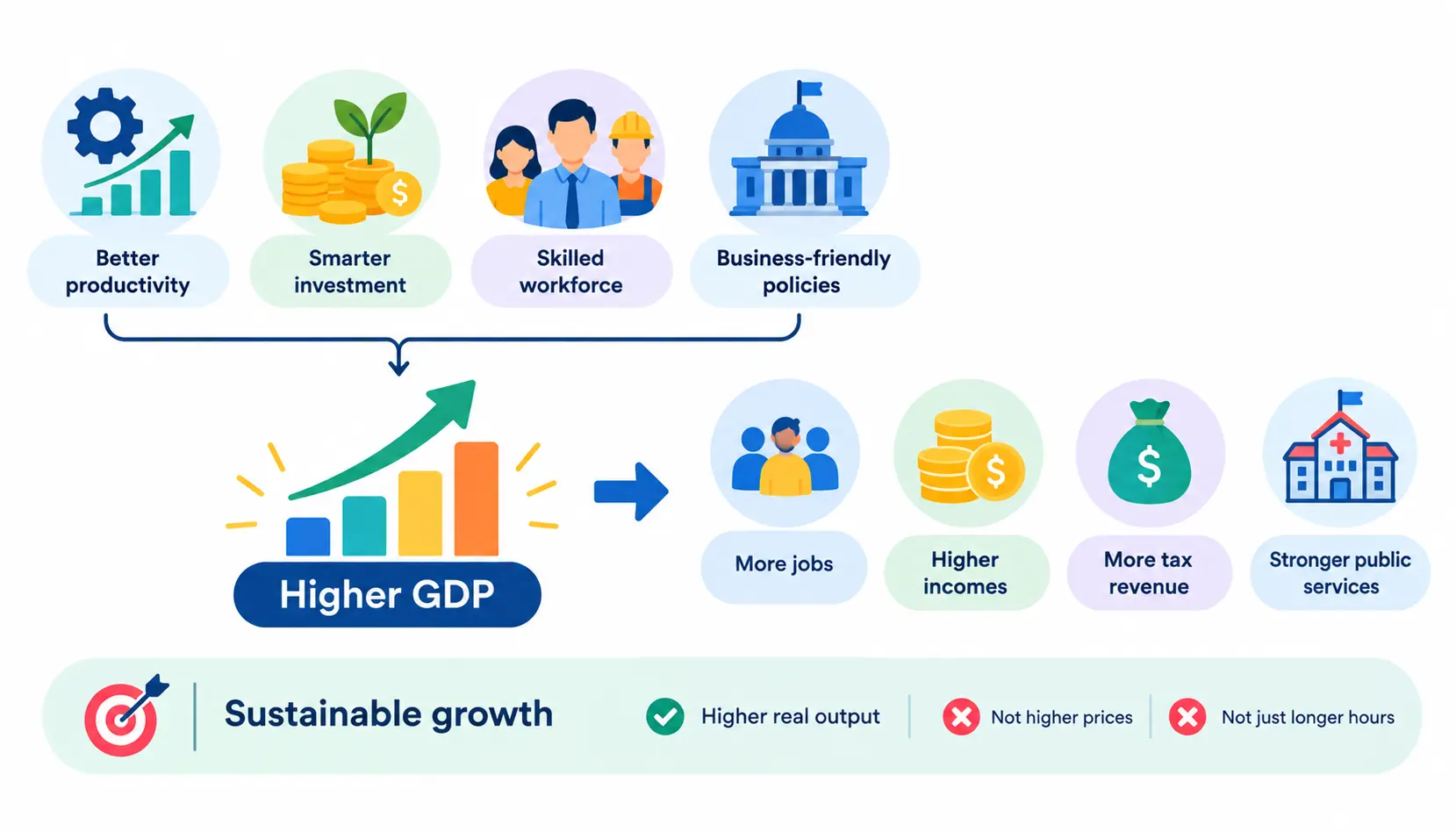
If you want to know how to increase GDP, the short answer is this: produce more goods and services with the resources you have. That usually means better productivity, smarter investment, a skilled workforce, and policies that let businesses grow.
GDP, or gross domestic product, is the total value of final goods and services a country produces in a period, usually a year or a quarter. Governments care about it because more output generally supports jobs, incomes, and tax revenue. It also gives them room to fund schools, hospitals, and infrastructure.
This guide covers the main drivers: productivity, investment, consumer demand, government policy, education, innovation, and trade. One point matters from the start. Sustainable growth means higher real output. It does not mean higher prices, and it does not mean people simply work longer hours.
What Does It Mean to Increase GDP?
What GDP measures
GDP adds up the market value of final goods and services produced inside a country’s borders. “Final” means we count the finished loaf of bread, not the flour that went into it. Otherwise we would count the same value twice.
Economists use GDP because it is a consistent, widely reported gauge of economic activity. Agencies such as the U.S. The Bureau of Economic Analysis and the World Bank publish it using standard national-accounts methods.
Real GDP vs. nominal GDP
Nominal GDP uses current prices. If prices rise 5% and output stays flat, nominal GDP still goes up. That looks like growth, but nobody is better off.
Real GDP removes the effect of inflation. It tells you whether the economy actually produced more. When people ask how to increase GDP, they almost always mean real GDP.
GDP vs. GDP per capita
GDP per capita is GDP divided by population. It shows average output per person.
Total GDP can rise simply because the population grew. If GDP rises 3% and the population rises 3%, the average person produces no more than before. GDP per capita is also an average. It says nothing about how income is shared.
How Is GDP Calculated?
The GDP formula
The expenditure approach adds up all spending on final output:
GDP = C + I + G + (X − M)
Here, C is consumption, I is investment, G is government spending, X is exports, and M is imports.
The four components of GDP
Consumption
This is household spending on goods and services, such as food, rent, healthcare, and phones. In most large economies it is the biggest component.
Investment
This covers business spending on productive assets such as machinery, buildings, and software. It also includes residential construction and changes in inventories. National accounts group these under gross capital formation.
Government spending
This is government purchases of goods and services, including public infrastructure, schools, and defense. Transfer payments such as pensions are not counted here, because they move money rather than buy output.
Net exports
Net exports equal exports minus imports. A country that imports more than it exports has negative net exports, which subtracts from the formula. That does not mean imports are bad, as we’ll see later.
A simple example of how GDP increases
Imagine a small economy with these figures (in billions):
- Consumption: 600
- Investment: 200
- Government: 250
- Exports: 150
- Imports: 200
GDP = 600 + 200 + 250 + (150 − 200) = 1,000.
Now a manufacturer builds a new plant. Investment rises to 250. The plant hires workers, so consumption rises to 610. It sells abroad, so exports rise to 180. But it also imports machinery and parts, so imports rise to 220.
GDP = 610 + 250 + 250 + (180 − 220) = 1,070.
The components interact. Imports offset part of the gain. If prices rose during this period, some of the 70 would be inflation rather than real growth. And one extra dollar of spending does not automatically create one lasting dollar of real GDP. It depends on whether the economy can actually produce more.
What Are the Main Ways to Increase GDP?
In brief, a country can increase GDP by raising productivity, encouraging investment, building skills, improving infrastructure, supporting innovation, sustaining consumer demand, using sound fiscal and monetary policy, improving the business environment, expanding trade, raising employment, strengthening key sectors, and attracting productive foreign investment. The sections below explain each one.
1. Improve labour productivity
Labour productivity is output per hour worked. It is the single most important long-run driver of living standards. Economists at the OECD track it closely for this reason.
Productivity rises when workers have better tools, better processes, and better skills. It also rises when waste and delays fall. Good management matters as much as new machines.
Here is a practical example. A furniture workshop replaces hand-cutting with a computer-controlled saw and reorganizes its floor layout. The same ten workers now finish 30% more orders per week. Hours did not change. Output per hour did.
That is the key distinction. Working more hours adds to output once. Producing more per hour keeps adding year after year. Businesses can calculate productivity by comparing output with the labour hours or other resources used to produce it.
2. Encourage business investment
When firms buy machinery, build facilities, or adopt new technology, they expand what the economy can produce in the future. Investment is both part of GDP today and a driver of GDP tomorrow.
Governments can help by improving access to finance and keeping rules predictable. Firms invest when they trust that contracts will be honored and policies will not swing wildly.
There are risks. Poor investment choices waste capital, and excessive borrowing can leave firms fragile when conditions change. Investment helps growth only when it is productive.
3. Develop education and workforce skills
Economists call the knowledge and skills of workers human capital. It is closely tied to productivity and innovation
Practical steps include better access to quality schooling, vocational training, apprenticeships, and lifelong learning. Skills programs work best when they match what employers actually need. Training people for jobs that do not exist helps no one.
An economy with skilled workers can also adopt new technology faster. A factory with advanced robots gains little if nobody can program or maintain them. At the business level, companies can measure employee productivity to identify skills gaps, improve workflows and understand how training affects output.
4. Invest in infrastructure
Roads, railways, ports, electricity grids, and broadband lower business costs. They also connect workers to jobs and firms to customers.
In my experience reviewing project proposals, the hard part is rarely the idea. It is project selection, maintenance, financing, and delays. A well-chosen bridge can pay off for decades. A poorly chosen one, or one that is built and then neglected, becomes a cost.
Reliable energy matters especially. Frequent power cuts force firms to buy backup generators, which raises costs and cuts output.
5. Support innovation, research, and technology
Innovation creates new products, industries, and markets. Governments can fund research and development, support startups, and help firms commercialize ideas.
But an invention is not grown until someone uses it. That takes skilled workers and healthy competition, because firms facing rivals have a reason to adopt better methods. Helping small businesses adopt practical digital tools, such as inventory or payment software, often delivers more than chasing headline technologies.
6. Encourage sustainable consumer demand
Households with steady jobs and rising incomes spend more. Confident consumers spend more still. That spending raises output when businesses have spare capacity to respond.
Tax policy and transfers affect disposable income and therefore demand. But there is a limit. If factories and workers are already fully used, extra spending mostly pushes up prices instead of production. Demand support works best when the economy has slack.
7. Use effective fiscal and monetary policies
Fiscal policy means government taxing and spending. It can lift demand and fund public investment. Monetary policy, set by central banks, influences interest rates and credit conditions. Lower rates can encourage borrowing, investment, and spending.
Each tool has trade-offs. Stimulus can raise inflation, increase borrowing costs, and add to public debt. The effect depends on economic conditions and timing. The same stimulus that helps in a recession can overheat a strong economy.
8. Improve the business environment and competition
Firms grow faster when it is easy to register a company, enforce a contract, and get permits. Simple administration saves time. Predictable regulation lets managers plan.
Competition matters too. It pushes firms to improve and lets good newcomers enter. Regulation still has a role in protecting health, safety, and consumers. Poorly designed deregulation can backfire, so the goal is smarter rules, not no rules.
9. Expand exports and productive international trade
Competitive exporters earn foreign income and reach larger markets. That lets them scale up and specialize where they have a real advantage. Quality standards, logistics, and trade agreements all help.
One common misconception is that cutting imports always helps GDP. It does not. Imports often supply machinery, components, and technology that make domestic firms more productive. Cutting them can lower output.
10. Increase employment and labour-force participation
More people working means more total output. Barriers to entering work include a lack of childcare, poor transport, and skills gaps. Addressing them can bring more people into the workforce.
Be clear about what this does. Higher employment raises total output. Higher productivity raises output per worker. Both matter, but they are different. Job quality and skills matching matter too, because a poor match wastes talent.
11. Strengthen agriculture and manufacturing
In many countries, farming and factories employ large numbers of people. Better irrigation, storage, and market access can raise farm output and income. Manufacturing builds supply chains, creates jobs, and often supports exports.
There is no single formula. A country with strong services or natural resources may follow a different path from one built on factories. Strategy should fit local strengths.
12. Attract productive foreign direct investment
Foreign direct investment (FDI) means a foreign company taking a lasting stake in a local business. At its best it brings capital, technology, skills, and market access.Predictable policy, decent infrastructure, and a trained workforce attract it. The best FDI also links to local suppliers and transfers skills. Investment that merely extracts resources, or has few local connections, adds less.
Do Tax Cuts and Government Spending Increase GDP?
They can, but neither guarantees lasting growth.
How tax cuts can stimulate growth
Tax cuts leave households with more income to spend and can improve business incentives to invest. The effect depends on which taxes are cut and who benefits. A cut that reaches people likely to spend, or that rewards productive investment, tends to have a larger impact.
Tax cuts also reduce government revenue. Gains may be limited or temporary, and some policies do not pay for themselves.
How public spending can support economic growth
Routine spending and public investment are not the same. Spending on infrastructure, education, research, and public health can raise future productive capacity. Day-to-day spending mainly supports current services.
Project quality matters. So does financing and long-term fiscal sustainability.
Why neither policy guarantees higher long-term GDP
Policies take time to design and take effect, and money spent in one place cannot be used in another. Large stimulus can raise inflation or interest rates. Context decides the outcome. A recession with idle workers responds differently from an economy already running at capacity.
How Can a Country Increase GDP Per Capita?
Increase output per worker
Productivity is the main source of rising average income. Over decades, small yearly gains compound into big differences in living standards.
Improve skills and access to productive jobs
Education, training, higher participation, and better job matching help workers move into roles where they produce more.
Build higher-value industries
Innovation, specialization, and business investment can raise value added, meaning the value created above the cost of inputs.
Improve the distribution of economic opportunity
Barriers such as distance, discrimination, or lack of services keep people out of productive work. Regional gaps can be wide. Remember, GDP per capita is an average and does not measure inequality or overall well-being.
Can a Country Increase GDP by Making People Work Longer?
It can, in a narrow sense. Total hours worked is one input to output. More hours or more workers can lift GDP.
But producing more per hour is a stronger path. Longer hours run into limits: tiredness, health problems, less leisure, and diminishing returns. Output per hour often falls when people are overworked.
The Business Council of Alberta has published an article on this theme, which is worth reading as a discussion point. Check any country-level figures against official statistics before relying on them.
Real-World Examples of Strategies to Increase GDP
Each example below lists the policy, the intended mechanism, the result, the period, and the source. None of them proves that one policy alone caused later growth.
Infrastructure investment
- Policy: The U.S. Interstate Highway System, authorized in 1956.
- Mechanism: Faster, cheaper road transport lowers logistics costs.
- Result: Economist John Fernald’s 1999 study in the American Economic Review found productivity gains, especially in vehicle-intensive industries, during the building period.
- Source: Fernald, “Roads to Prosperity?” (1999).
Education and innovation
- Policy: Singapore’s SkillsFuture program, launched in 2015.
- Mechanism: Lifelong learning credits help workers update skills as industries change.
- Result: Check the program’s official evaluations and national statistics before citing outcomes. Training effects are hard to separate from other factors.
- Source: Singapore’s SkillsFuture agency and Ministry of Manpower.
Export-led industrial development
- Policy: South Korea’s export-oriented industrialization from the 1960s onward.
- Mechanism: Firms built manufacturing capability, competed in global markets, and learned from international standards.
- Result: South Korea moved from low income to high income within a few decades. Scholars credit exports alongside education, investment, and other factors.
- Source: World Bank data and the Wikipedia summary of the Miracle on the Han River.
India’s approach to economic growth
India has focused on manufacturing, entrepreneurship, infrastructure, investment, and MSME (micro, small and medium enterprise) development. Programs include Make in India (2014), the Goods and Services Tax (2017), and Production Linked Incentive schemes (2020).
The Press Information Bureau’s 2019 release is useful only as a record of what the government announced at that time. Before making claims about India’s current performance, use recent data from the Ministry of Statistics and Programme Implementation, the Reserve Bank of India, and the IMF.
What Prevents GDP From Growing?
Low productivity and weak investment
When firms lack capital and run inefficiently, output stays low.
Inflation and macroeconomic instability
Rising prices alone do not mean real growth. High or volatile inflation also makes planning harder.
Skills shortages and labour-market barriers
If workers lack the skills firms need, production stalls even when people want jobs.
Poor infrastructure and unreliable energy
Delays and outages raise costs and waste time.
Excessive debt and inefficient public spending
Borrowing has an opportunity cost. Money spent on interest cannot fund schools or roads, and low-quality spending adds little output.
Weak institutions and uncertainty
If rules change unpredictably or contracts are hard to enforce, firms hold back investment.
How to Measure Whether GDP Growth Policies Are Working
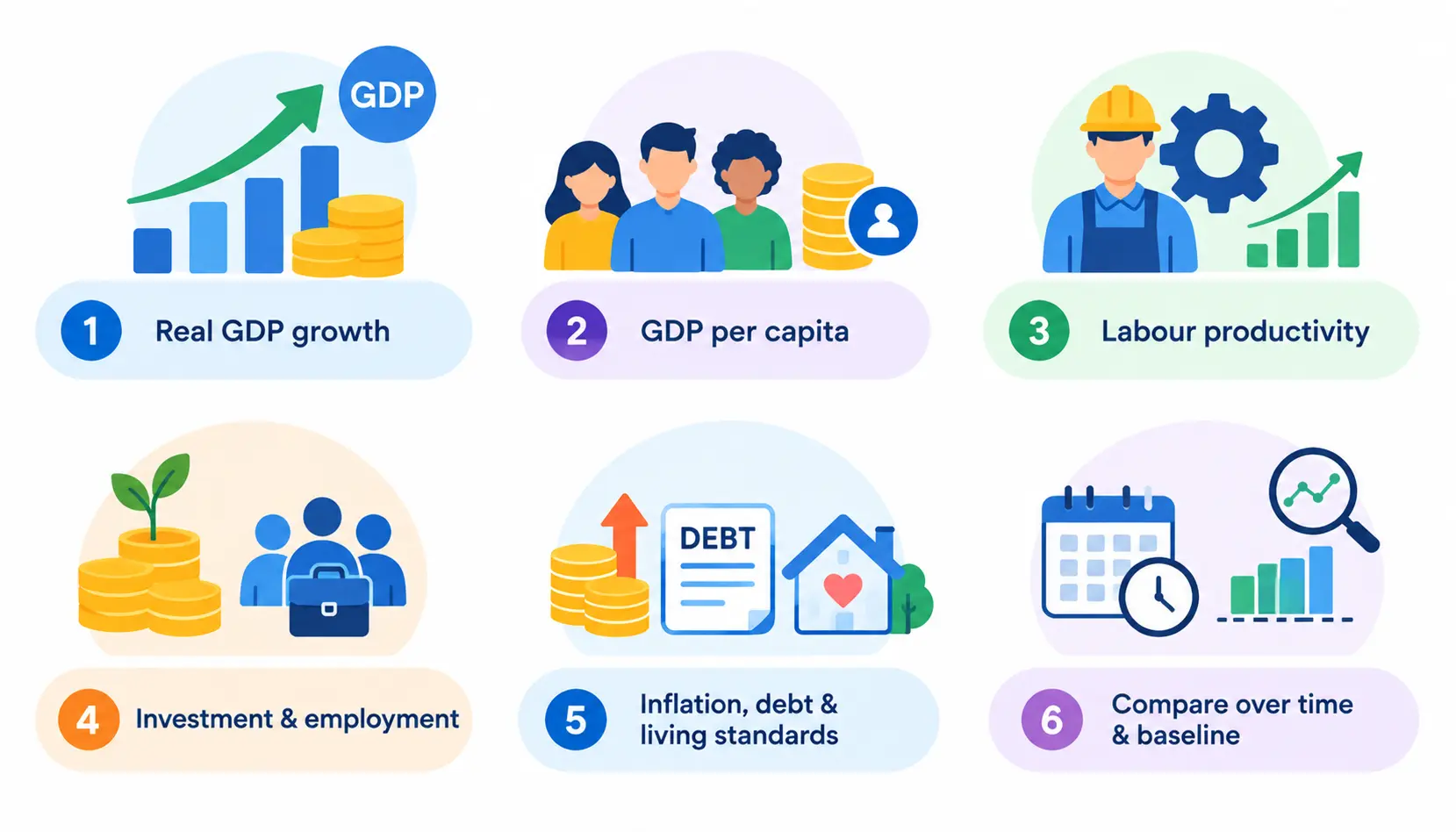
Track real GDP growth
Use inflation-adjusted output to see whether production actually rose.
Track GDP per capita
This shows average output relative to population. Keep its limits in mind.
Monitor labour productivity
Measure output per hour worked, or another clearly defined measure.
Track investment and employment
Capital formation, employment, and participation show how growth is developing.
Monitor inflation, debt, and living standards
GDP alone is not a verdict. Also check price stability, fiscal sustainability, real incomes, and social indicators such as health and education.
Compare results over time and against a baseline
Define the starting period and measurement method. Allow for data revisions and shocks such as pandemics or commodity swings. Compare results with what the policy was expected to do. And remember that correlation does not prove causation.
Short-Term vs. Long-Term Strategies to Increase GDP
| Short-term approaches | Long-term approaches |
| Targeted demand support | Education and skills development |
| Temporary fiscal stimulus | Infrastructure and capital investment |
| Measures to restore confidence and credit access | Research, innovation, and technology adoption |
| Removing immediate supply bottlenecks | Competition, institutional quality, and business formation |
These categories overlap. A well-designed infrastructure project can create demand and jobs now and improve productive capacity later. Outcomes depend on design, timing, and execution.
Frequently Asked Questions About Increasing GDP
1. What are the main ways to increase GDP?
The main ways are raising productivity, encouraging investment, building skills, improving infrastructure, supporting innovation, sustaining consumer demand, increasing employment, and expanding productive trade.
2. What is the fastest way to increase GDP?
It depends on the problem. If demand is weak and capacity is idle, demand support can work quickly. If supply is constrained, adding demand just raises prices, and fixing bottlenecks matters more.
3. Does government spending increase GDP?
Yes, directly, because government purchases are a component of GDP. Wider effects depend on what is bought and how it is financed. Spending can lift measured output in the short term, while long-term gains come mainly from productive investment.
4. Do tax cuts always increase GDP?
No. The result depends on the type of tax, who receives the cut, the fiscal context, and the wider economy.
5. How does productivity increase GDP?
Productivity means producing more value with the same resources. That raises output without needing more workers or hours, and it supports higher incomes.
6. Can GDP increase without increasing population?
Yes. Higher productivity, investment, and output per worker can raise total GDP even if the population stays flat.
7. What is the difference between GDP growth and GDP per capita growth?
Total GDP and population can grow at different rates. GDP per capita growth shows whether average output per person is rising.
8. Does higher GDP mean a country is wealthier?
Not necessarily. GDP measures production in a period. It does not measure national wealth, household wealth, income distribution, or every part of quality of life.
Conclusion
Knowing how to increase GDP comes down to a few principles. Produce more per hour. Invest in capital, skills, and infrastructure. Keep rules predictable and markets competitive. Use fiscal and monetary tools carefully.
No single policy works everywhere. Context, timing, and execution decide results. Measure progress with real GDP, GDP per capita, productivity, inflation, debt, and living standards together.

Mehreen Mushtaq is a skilled content writer dedicated to creating high-quality, engaging, and SEO-focused blogs. She specializes in strategic keyword usage, search intent, and informative content that connects with readers while helping websites strengthen their visibility and rankings in search results.